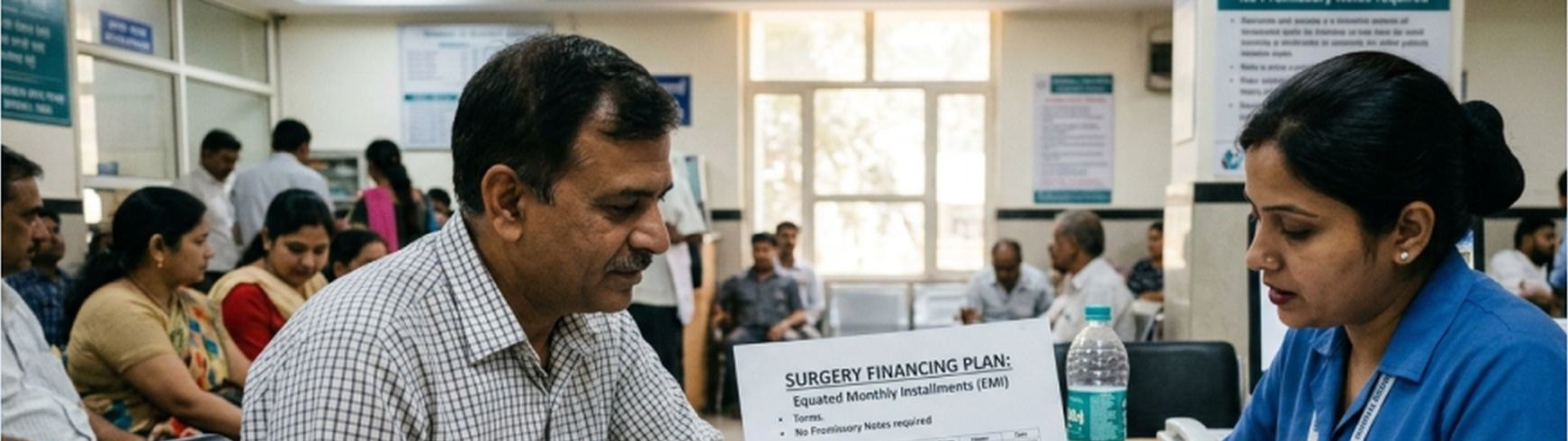
Surgery Financing in India: How to Plan Instalments Without Relying on Promises
Funding routes, card instalments, BNPL checks and total cost
6 minute read
A family can agree that treatment is affordable overall and still struggle with the timing of the payment. Hospitals may require a deposit before admission, a larger amount before surgery and settlement before discharge. Travel, accommodation and time away from work add pressure at the same moment.
That is why “Can we afford the operation?” and “Can we fund the invoice on the hospital’s schedule?” are different questions.
Surgery financing in India can involve insurance, savings, a regulated loan, a credit-card instalment feature, an approved payment plan or help from an employer or family. The important distinction is between a product that exists in your home market and a facility that can actually be used for this Indian hospital invoice.
Separate the treatment bill from the funding plan
Start with a hospital-issued estimate. It should state the procedure, expected stay, room category and inclusions. Ask what must be paid before admission, what can be settled later and which costs are variable.
Then add the non-hospital budget: visa fees, flights, local transport, accommodation, meals, an attendant’s expenses, medicines after discharge and a contingency reserve. Financing only the quoted procedure can leave the family short during recovery.
Once the total cash-flow need is clear, compare funding routes on the same basis. Do the comparison before paying a non-refundable deposit. A financing application can be declined, approved for less than requested or delayed beyond the planned admission date. Keep the medical booking conditional until the payment path is genuinely available. If treatment is time-sensitive, ask the hospital what minimum deposit preserves the date and whether another safe payment method can be used while a regulated application is reviewed. Never postpone urgent care solely to wait for a promotional offer; discuss timing with the treating clinician.
| Funding route | Typical structure | What to verify | Biggest limitation |
|---|---|---|---|
| Funding routeInsurance (cashless or reimbursement) | Typical structureInsurer or TPA pays the authorised portion | What to verifyNetwork confirmation, pre-authorisation and usually a Guarantee of Payment | Biggest limitationAssuming the approval covers every item on the final bill |
| Funding routeSavings or family funds | Typical structureDirect hospital payment | What to verifyLiquidity after travel and recovery costs | Biggest limitationReduces emergency reserves |
| Funding routeRegulated personal or medical loan | Typical structureFixed instalments over an agreed tenor | What to verifyAPR, fees, eligibility, disbursement and early repayment | Biggest limitationApproval and total cost vary by lender |
| Funding routeCredit-card instalment or balance conversion | Typical structureHospital charge converted by issuer | What to verifyInternational eligibility, credit limit, FX and conversion terms | Biggest limitationA card transaction may not qualify after it posts |
| Funding routeBNPL or merchant payment plan | Typical structureInstalments through a participating checkout | What to verifyMerchant participation, transaction cap and fees | Biggest limitationRetail availability does not mean hospital availability |
| Funding routeHospital or facilitator plan | Typical structureDeposit plus scheduled payments | What to verifyContracting party, payment destination and refund rules | Biggest limitationOften case-specific and may not be credit financing |
Route 1: insurance before borrowing
If the policy may cover planned treatment in India, complete the insurance check first. Even partial coverage can reduce the amount that needs financing. Confirm whether the insurer will pay the hospital directly or reimburse the family later. Reimbursement creates a temporary funding need even when the final claim is expected to be eligible.
Do not borrow against an estimate until you understand the deductible, co-payment, benefit limit and exclusions. Read the companion Curify guide on insurance coverage for the authorisation sequence.

Route 2: a regulated loan
A personal or purpose-linked medical loan may provide a defined amount and repayment schedule. Compare the annual percentage rate (APR), processing fee, insurance add-ons, late-payment consequences and early-repayment terms rather than comparing only the monthly instalment.
For Saudi customers, SAMA’s consumer-finance framework requires mandatory charges to be included in APR disclosures, and its credit-card rules define APR as the total cost of credit under the applicable calculation rules [1][2]. Other countries have their own disclosure standards. Ask for the key facts or equivalent pre-contract summary from the regulated lender in your jurisdiction.
Before signing, establish whether funds are paid to you or directly to the hospital, how long disbursement takes, and what happens if the treatment date or cost changes.
- The exact services covered by the payment schedule
- The total amount repayable, including fees
- Cancellation and refund terms
- What happens if the clinical plan or admission date changes
A coordinator can help move documents and payments, but it should not be presented as the lender unless it is legally providing the finance.
An illustration, not a quotation
Suppose a planned procedure is estimated at INR 600,000. If that amount were divided equally with no interest, fees or foreign-exchange cost, the arithmetic would be:
| Illustrative tenor | Principal | Equal payment |
|---|---|---|
| Illustrative tenor4 payments | PrincipalINR 600,000 | Equal paymentINR 150,000 |
| Illustrative tenor6 payments | PrincipalINR 600,000 | Equal paymentINR 100,000 |
| Illustrative tenor12 payments | PrincipalINR 600,000 | Equal paymentINR 50,000 |
Real financing will rarely be this simple. APR, processing charges, taxes, currency conversion, card fees and the timing of the first payment can change both the instalment and the total. The example is a budgeting tool, not an offer.
Before you rely on instalments
- Obtain the hospital estimate and deposit schedule in writing.
- Keep a separate reserve for travel, accommodation and unexpected care.
- Confirm that international transactions are enabled and the card limit is sufficient.
- Ask the issuer or lender about APR, fees, FX and early repayment.
- Verify the hospital’s merchant and payment-gateway eligibility.
- Check refund mechanics if treatment is postponed or the estimate changes.
- Do not pay a personal bank account when the contract names a hospital, platform or lender.
- Keep receipts, contracts and authorisation messages together.
Frequently asked questions
Can I pay for surgery in India in instalments?
Yes, sometimes. Instalments may come through a loan, card conversion, hospital-linked plan or lending partner, but approval and payment route must exist before admission.
What is the safest way to finance surgery in India?
Start with the hospital estimate, insurance eligibility and total travel budget. Then choose a regulated option with clear APR, fees, disbursement and refund terms.
Should I use insurance before taking a medical loan?
Yes. Check insurance first because an approved benefit can reduce the loan amount, deposit pressure and temporary cash-flow need.
Can I use credit card EMI for an Indian hospital bill?
You can use card EMI only if your issuer allows that overseas hospital transaction and your limit covers the deposit, fees and currency conversion.
Can Tabby, Tamara or BNPL pay for surgery in India?
Usually not automatically. BNPL works only if the app supports the country, hospital merchant, transaction value and healthcare payment type.
How do I compare surgery loan or EMI options?
Compare total repayment, APR, processing fee, foreign-exchange cost, tenor, early repayment rules, late fees and when the hospital receives funds.
What if the surgery cost changes after financing approval?
Ask for a revised estimate and updated payment plan immediately. The extra amount may need fresh approval, another payment method or a larger deposit.
Plan the payment with the treatment
The best financing plan is one that still works after travel, recovery and follow-up costs are included. Confirm the treatment estimate first, compare regulated funding on total cost, and verify the real payment path from lender or card issuer to hospital.
Curify presents financing, insurance and assisted medical travel as part of its service [3]. Ask which facilities are live for your country and hospital, who provides the finance, and what eligibility rules apply before you make a booking.
Ask Curify AISources and verification notes
- Saudi Central Bank (SAMA), Rules of Issuance and Operation of Credit Cards, in force from 19 June 2025.
- Saudi Central Bank (SAMA), Rules Governing Calculation of Annual Percentage Rate.
- Curify, official website (service description).